6 SKILLS AI CAN NEVER REPLACE
Everybody is asking the wrong question about AI.
“Will AI take my job?” is lazy thinking, though I empathize with the fear.
A better question is: What human behaviors become more valuable when average-level thinking becomes free?
Daniel Pink recently shared a video entitled “The 6 Skills AI Will Never Replace.” I’m no Daniel Pink, so I won’t challenge his assertions and predictions, nor will I try to write my own and pretend I didn’t take them directly from him. He’s a genius, let’s go with what he said.
In this article, we will try to put a little more meat on the bone for how these skills play out in organizations, and to better identify the true leadership behaviors that are irreplAIcable. (See what I did there?) Because right now, organizations are still over-rewarding the exact things that AI can rapidly democratize: speed, information recall, slide decks, etc. So let’s double click on the human skills that we need now, perhaps more than ever.
OK, here we go. In Daniel Pink’s order, here are the 6 skills:
1. Questions
We need leaders who diagnose before they prescribe
The best leaders in the AI era won’t be the ones with the fastest opinions. They’ll be the ones who slow the room down long enough to ask:
“What problem are we actually solving?”
“What assumptions are we making?”
“Who is impacted that isn’t in this room?”
“What happens if we do nothing?”
The modern leader’s job is not to be the smartest person in the room; it’s to create smarter rooms. That requires curiosity, and not the bullshit performance kind of curiosity that sounds like judgment wrapped in passive-aggressiveness. Genuine curiosity for what’s happening, why it’s happening, how we can improve it, and what we can learn from it.
What’s the leadership behavior? COACHING
A coach asks questions to help guide the employee to find their own answers. A coach builds the capability of the team members so they think on their own, reduce dependencies, and develop more critical thinking abilities. We don’t need leaders to race for the fastest answer, we need leaders who invest their time wisely into their team members’ development.
I have a client who was thrown off his chair by the power of question I asked him. Want to know the question? It was “what other options did you consider before choosing this path?” Mind blown. Why? Not because it was that deep a question, but because he hadn’t considered any other options! None. It never occurred to him. By asking a simple question, he decided he needed to play out a few scenarios to see which would produce the best results. And guess what? He changed his tack after doing this. Building a coaching habit takes a bit of time (as evidenced by the leader going back to map out other possible solutions), but it’s an investment that will pay dividends on the back end by producing more independent, informed, growth-oriented employees who will increasingly be able to solve more and more complex challenges. That guy will never NOT consider multiple options before making his recommendation again.
2. Taste
We need leaders who can discern between good and garbage.
As Mr. Pink says, AI can generate 100 ideas in 8 seconds, but 97 of them will be crap. Quantity is no longer impressive. We need judgment, analysis, discernment.
Can you recognize:
a strong strategy versus corporate word salad?
a compelling message versus jargon soup?
a genuinely human interaction versus “per my last email” energy?
Leaders who can map out a problem, get to the heart of the issue, consider multiple viewpoints, look at several options and pick the best path forward are the ones that will succeed the most.
To add to that, can you recognize:
· When an employee is struggling with their work?
· When a team is in turmoil?
· When your change initiative is meeting resistance?
· When you’ve lost the room?
The ability to recogniz the uniquely human experience is the hallmark of a successful leader. This isn’t about getting touchy-feely about our emotions, it’s about understanding the experience of people in the room and using that information as data to make more thoughtful and effective decisions.
What’s the leadership behavior? EMOTIONAL INTELLIGENCE
A leader with high emotional intelligence will better navigate relationships, is better equipped to have hard conversations, and will be more effective at bringing the team along with them on a change journey. This leader will know when to hit ‘pause’ on the plan to check-in with folks and when to hit ‘play’ because the team is firing on all cylinders.
3. Iteration
We need leaders who stop waiting for perfect
We can iterate at speed with AI helping us. So if you’re a leader who spends six months “socializing the framework” before testing anything, well, you’re behind.
We saw this with the introduction of agile in product development; now we can be agile in everything! Good leaders are testing their ideas early, getting immediate feedback, prototyping, adapting, and not treating change or failure like a personal attack. They improve in public, not in private.
What’s the leadership behavior? HUMILITY
The future belongs to organizations that can learn faster than they can posture, and that requires leaders who are humble enough to fail publicly and share their learnings with others. We need leaders who model the ethos of trying something, getting feedback, learning, building something better, and spreading the insights far and wide for the greater good of the organization. We do NOT need leaders who fall in love with their own first idea, or who care more about looking good than doing good.
4. Composition
We need leaders who connect dots that other people miss
While AI is excellent at producing “ingredients,” we still need to be the ones who take those ingredients and create meaning out of them. Employees aren’t inspired by the ingredients or the various pieces – they’re inspired by the outcome, the impact, the purpose.
We need leaders who can:
synthesize conflicting information
link strategy to emotion to inspire others
connect departments that barely speak
translate complexity into clarity
This is why cross-functional leadership, and having a generalist viewpoint, matters in today’s world.
What’s the leadership behavior? SYNTHESIS
The valuable leader is the one who can zoom out, integrate perspectives, and create coherence when everybody else is drowning in noise. Good leaders can look at a lot of pieces and understand how they fit together to create something bigger and better. The best leaders can do all of that and then communicate a compelling story to their audience in a way that moves them emotionally. This creates connection and commitment to the organization, and a culture that drives true meaning in our work.
5. Allocation
We need leaders who know what team members should be doing (and what they actually want to be doing)
One of the dumbest ways organizations are using AI is to automate the meaningful work that requires thought (e.g. writing, creating imagery, art) and leave humans drowning in administrative bullshit. That’s not a good strategy. In fact, that means you’re driving your teams and companies straight toward mediocrity.
The leaders who are standing out are redesigning work around human strengths instead of simply using AI to squeeze more productivity out of already exhausted people. So this is where allocation comes in:
What should AI handle?
What requires human judgment?
What does this person actually enjoy doing?
Where does nuance matter?
Where does creativity matter?
So this is about allocating the right resources for the right tasks in the right ways. It’s also about leveraging uniquely human attributes to not only build better products and systems inside the organization, but also to bolster the careers of those on your team.
What’s the leadership behavior? CAREER CONVERSATIONS
Leaders need to have an intimate understanding of what team members are good at, where they need development, what they enjoy doing, what drains them, and generally what motivates them. Having one-on-one career-related conversations will not only strengthen your relationship with your team members, it will give you the data you need to most effectively allocate the resources on your team, human and otherwise.
6. Integrity
We need leaders who remain trustworthy when nobody knows what is real
This one is the big one. AI makes it easier to fake expertise, fake productivity, fake originality, fake consensus, and fake confidence. It hallucinates, it makes shit up, it is flat out wrong.
In this day and age, integrity is a competitive advantage. There’s a lot written about accountability, but I prefer the concept of integrity. Integrity is doing what you said you were going to do. Integrity is about showing up authentically and with the best intention to do what’s “right” in your own subjective way.
So, ask yourself, can people trust your motives? Your judgment? Your decisions? Do they trust you to act ethically? Do they trust that you’re looking out for them? In the AI era, trust becomes currency. And once trust erodes, not much can save you.
I was doing a 360 review for a CTO recently. Despite his apparent success in delivering the technology, in recreating the team, in solving customer issues, and in building a new business model, he did not build the trust of the people around him. His direct reports didn’t feel that he had their back; his peers felt he would throw them under the bus if the CEO was around; the CEO didn’t believe he was sharing the whole story. People perceived him as self-serving. He’s now gone. Fired. Results matter, sure, but character matters more.
AI is not just accelerating productivity, it’s exposing character.
What’s the leadership behavior? TRUST
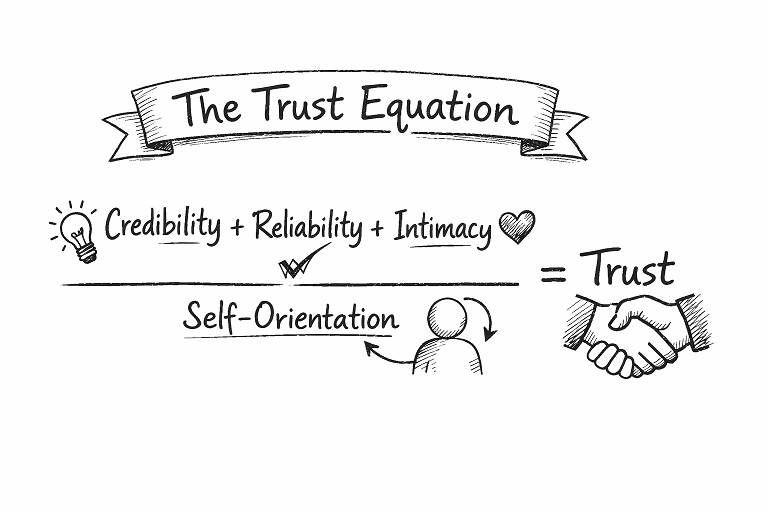
My favorite trust model is this:
C + R + I / SO (see below for a better image). It’s less a model and more of an equation.
C is for Credibility (this person has the skills and education and knows the thing). R is for Reliability (this person does what they say they’ll do). I is for Intimacy (this person can keep a secret). SO is for Self-Orientation (this person is looking out for themselves first). If you add up a score for credibility, and reliability, and intimacy, that’s the numerator. Self-Orientation is the denominator. Do the math.
What I love about it is that no matter how high your scores may be in credibility and reliability and intimacy, if your score is high in self-orientation, you will NOT build trust. No way. No how. And, the flip side is true too. Even if you’re not that credible (e.g. don’t have the right degree) or if you’re not that reliable (you are late to meetings or forget sometimes), or if you sometimes spill the beans (big mouth!), if people believe that you’re in it for the team, and you’ll sacrifice yourself for others, your trust score can be quite high.
Moral of the story: there’s no room for selfishness, posturing, or leadership theater. Look out for your team members, look out for the good of the organization, and show up with a service mindset.
---------
While the world becomes more automated, leaders need to become more human. Double down on the people; the dividends are compounding. Oh, and check out DPink’s video, it’s pretty good.