

crack the code of you:
leadership assessments for every type
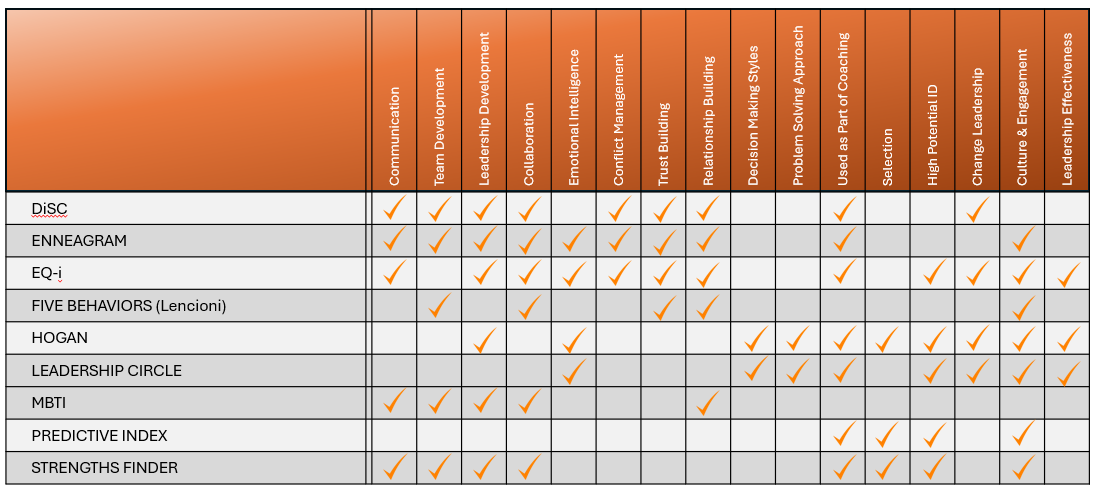
which assessment is right for you?
Download the white paper
Are you using leadership assessments to their full potential? This free whitepaper reveals the hidden power of tools like DiSC, Enneagram, Hogan, and StrengthsFinder. Spoiler alert, the value is not necessarily in the results, but in the conversations they spark.
Inside, you’ll find:
Real-world stories of how assessments helped leaders and teams break through
Insights into how assessments build trust, empathy, and collaboration
Strategies for turning data into dialogue
story time
Disc is for discovery

Recently, we began working with the two co-founders of a tech company. There was a fascinating (though to be honest, not uncommon) paradox between the perceptions of the founders and the team: the founders wanted the team to step up and take more ownership, while the team wanted the founders to step back and empower them. The founders felt that because the team wasn’t taking on more, they needed to retain control. The team felt they were ready to own the role, but the founders kept their hands in everything. You’ve likely seen the same dynamic. Like I said, not uncommon.
As part of a day-long offsite, we introduced the DiSC profile. What we learned was that the founders were extremely high on the D (dominance: typically forceful and assertive and like to be in control), and the rest of the team leaned closer to the S style (steadiness: typically calm, patient, supportive, team-oriented). How did we make sense of this? We didn’t…we let the team make sense of it themselves.
The founders realized they had hired people that would go along with their directive styles, rather than challenge it. They learned that unless they took an active step backwards, and made it part of the team’s expectations, this team would not naturally step in to the dominance the founders hoped for. The team also gained more insight into why the founders may have trouble stepping back. Through the dialogue, they realized they needed to stretch themselves to step in more, be more assertive, and take more control.
Sometimes the power of these tools isn’t in what they tell us about people, but in what they let people tell each other.
hogan is the hero

We developed a global, high-potential, senior leadership development program for an insurance company. Sounds fancy, right? It was! It was a total of 6 days in person (half in the US, half in the UK), virtual sessions, individual coaching sessions, and more. To propel the coaching, we administered the Hogan assessment, so each leader would get a full sense of their values, the ways they are perceived when they are at their best, and their potential derailers.
The collective results of the assessment gave us insight into the strengths and weaknesses of the group as a whole. It helped us shape the design of the training sessions to be directly connected to the skills and perceptions they needed to improve. So when we talked about emotional intelligence, for example, it wasn’t a theoretical conversation, it was specifically related to their scores, and precisely connected to the impact they have on others. There is nothing more gratifying for leadership geeks like us than to fundamentally change the level and intensity at which people are paying attention. When the content is directly about them, personalized to their situation, and immediately applicable, the learning crystallizes at a deeper level. And you can see it in real time. Using the Hogan to drive the content gave us that power, and helped us have the impact we intended.
The Hogan also allowed us to have personalized coaching conversations that began with the perception of them from others, rather than a more traditional (read: boring) “what would be most helpful to talk about?” type of coaching question. This allowed us to go deep on the coaching right from the beginning, bypassing the more surface rapport-building that is often necessary.
It's not that assessments expose your dark side, it just gives everyone permission to admit they have one.
enneagram > instagram

The leader of the Medical Affairs team at a biotech company – let’s call him Sanjay – was coming into a period of high intensity and high focus. It was a classic case of “what got us here won’t get us there.” So, he was forced to take a hard, deep look at his leadership.
We interviewed every member of his team and heard consistent, troubling feedback about Sanjay: he never says the ‘hard’ thing, he doesn’t solve or mediate conflict, he ignores problems. This was leaving the team feeling abandoned during hard times, and left to their own devices to move their own programs forward. It naturally created a very siloed department, as each leader shrank their focus to be solely about the teams they lead, rather than the team they were on.
Sanjay took the Enneagram. He is a ‘social 6.’ Upon reading his results, he just about melted. He shared with us the troubling stories of his upbringing: running from insurgencies in India forced his family to Africa, wars in Africa forced his family to the UK, racism forced his family to the USA. Being loyal to a group, putting safety first, avoiding conflict (all parts of a social 6 enneagram style) was how he survived.
With a little coaching, Sanjay shared his assessment results and some of these personal stories with his team. One by one, the team softened towards their leader, learning things they never knew, and hearing stories about his life that truly moved him. Slowly, his actions began to make sense to them. What they interpreted as disinterest or fear was actually survival and loyalty. This level of disclosure immediately made the team feel closer to their leader and to each other, but more so it gave them an understanding of why Sanjay acted the way he did. And with some help, the team developed strategies to get what they needed from their leader. They moved from empathy and understanding to a pragmatic protocol to move projects forward. And in the process, their relationships moved from surface and superficial to connected and consequential.
Assessments don’t box you in, they hand you the keys to the box you’ve been sitting in for years.